

The Flow Chart
How Will You Get from How Things Are to How Things “Should” Be?

The work of living involves cleaning up messes.
Sometimes they’re your own messes, but a lot of the time, they’re not.
There are guys out there who say that whatever happens to you is YOUR FAULT.
But it isn’t.
It’s good to take ownership over your situation, but plenty of things will happen in life that are completely out of your control. It’s what the ancients called “fate” and that’s also why people believe in luck.
Heraclitus wrote that “the thunderbolt steers all things.” There are many ways to interpret that, but storms come out of nowhere. I was running an event recently and all of the weather reports were wrong. We got thunder and lightning three hours later than we were supposed to.
There will be unforeseen plagues, tornados, and hurricanes. Something can fall off a truck and smash your windshield. Someone could invent something that makes your job obsolete. And yes, sometimes the worst people come into power and the worst ideas become popular.
You rarely get to start working from how things “should be.” In fact, if you did, there wouldn’t be any work to do. Congratulations, everything is perfect. Sounds pretty boring.
You have to begin work by acknowledging the reality of the situation before you. If you want to change that situation, you need to come up with a plan to move things closer to how you think things “should be” or how you want them to be.
When someone wants to sell me on how things “should be,” I ask to see their “flow chart.” What is the actual sequence of steps required to achieve the outcome you want? What challenges will you face, and how will you handle them? What resources are required?
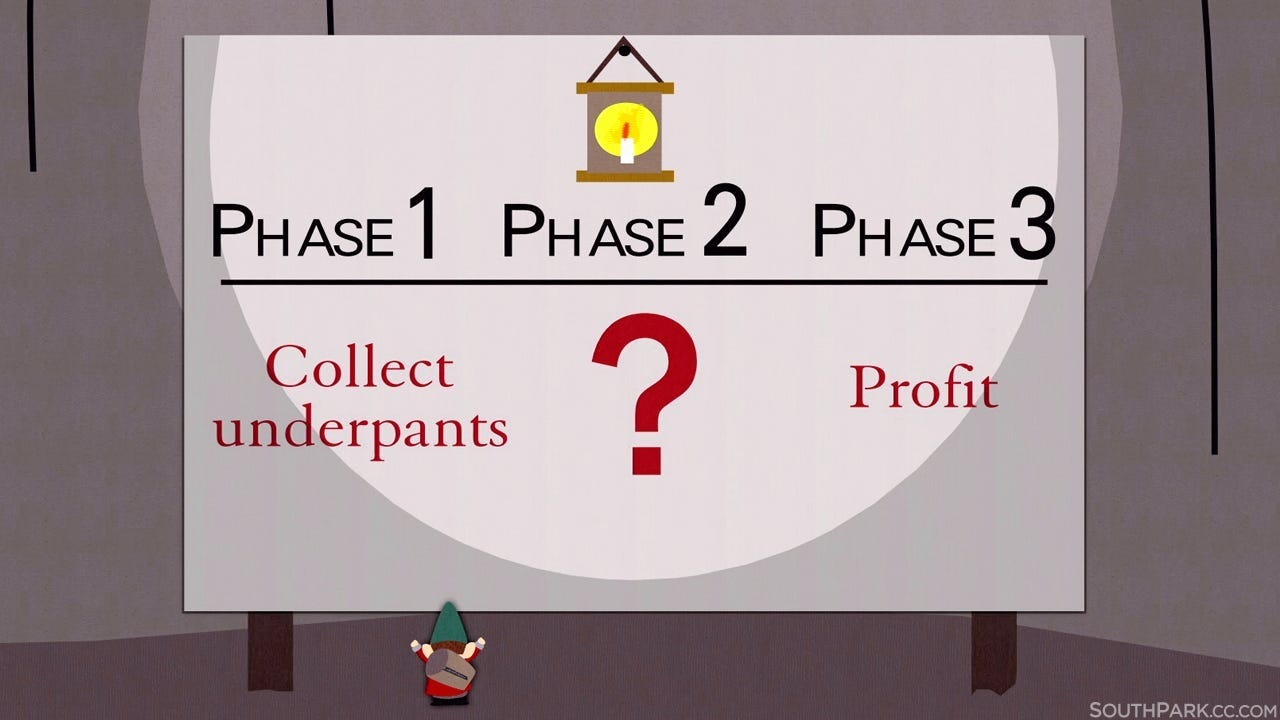
There’s an old South Park Episode in which gnomes present a business plan which starts with “collect underpants” and the goal is “profit.” Phase 2 of the plan (which is essentially the whole plan) is a big question mark.
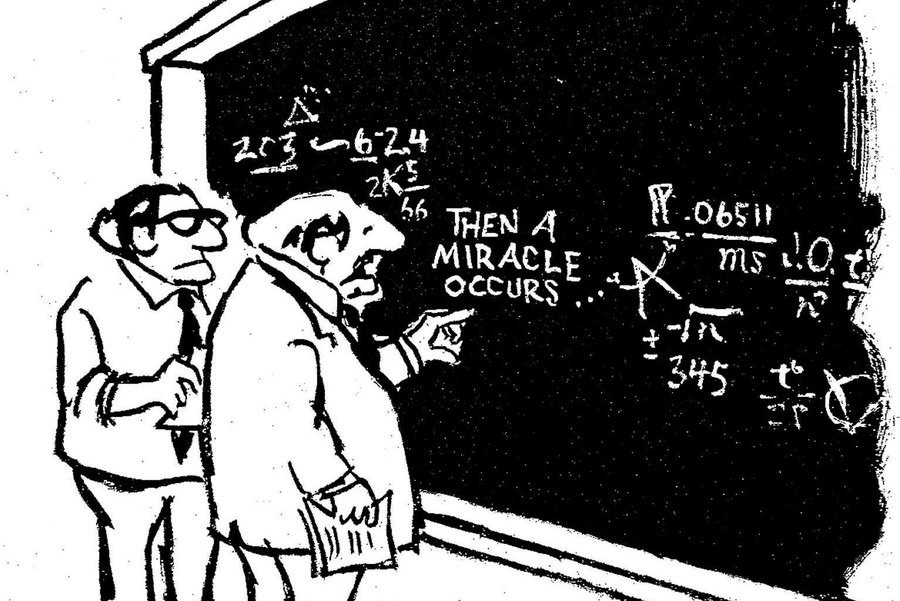
There’s an older cartoon, familiar in math and science circles, in which the second step of a mathematical derivation is scribbled out as “Then a miracle occurs.”
How are you getting from “collect underpants” to “profit???,” and what miracle needs to occur for you to get there?
Let me see your flow chart. Work the plan out.
A lot of people get fixated on things that they think “should” happen, but fail to address substantial obstacles in the way. I may even agree with them about what I think “should” happen. But that doesn’t mean that it’s going to happen.
This is true in every area of life, but seems to be especially true of politics. People who truly understand politics understand that it is the “art of the possible.” But 90% of the population seems completely unable to conceptualize the obstacles on the political landscape. They just want what they want.
I see guys all the time saying things like “THOSE people should be tried and hung!”
It sounds really tough to say that. Like you’re ready to make the hard, ugly decisions and say things other men are afraid to say.
In some cases, I probably agree with you.
But how does that get done? Realistically speaking? You’re obviously not just going to do it yourself. What are the things preventing that from happening? How are similar, less extreme propositions being received, and what does that tell you about the likelihood of your desired outcome?
But, because they aren’t working out the flow chart, they just get mad because their totally out-of-pocket idea isn’t being implemented. So, to anyone serious, it sounds more like a tantrum than a rational proposal.
And what’s worse is that when you are obsessively vocal about an extreme, far-fetched outcome, you are more likely to be dismissed as an unserious person who is just venting and that makes you less able to help your allies achieve an incrementally better step in the right direction.
I’m not saying you shouldn’t have ideals, or some sense of how you really think things “should” be.
Of course you should.
However, an ideal is a direction, not a destination.
A flow chart is also a good way to evaluate your ideals themselves. Is human nature one of the obstacles you’d have to overcome for things to be the way they “should” be? People everywhere on the political spectrum have ideals that are totally inconsistent with the thousands of years of data we have concerning human behavior. Has what you want ever happened or lasted very long? If not, why not?
If you’re thinking that there is also a danger in being overly cautious or waiting to work out the perfect plan, you’re right. That can become a form of procrastination. Acting on an imperfect plan is usually better than waiting until you’ve worked out every last detail. But at least have some kind of plan that doesn’t require a miracle to happen.
The plan that works will also probably not be the plan you started with. You will have to update the plan as you proceed and the situation evolves.
A good model for this process is John Boyd’s OODA decision making loop. OODA stands for Observe, Orient, Decide, Act. Actions produce responses that provide new information. New information requires reorientation and new decisions will have to be made that lead to new actions, and the loop repeats. This is true in business and grappling and even personal relationships.
Big changes are possible. I’ve seen them happen in my lifetime and I’ve even been surprised a few times. I’m not one of these doomers who believes that “nothing ever happens.” But when change does happen, it generally happens because a lot of people worked together to implement realistic incremental plans that laid the foundation for that change.
No big changes happened because a bunch of people sat around complaining about how things “should be.”
That’s like saying “I should be a millionaire.” You could be, but you’re going to need some kind of plan to get there that realistically acknowledges the obstacles in your way.
Many of the problems we face today took years to create.
We have inherited a big mess. A lot of things happened that “should not” have happened. Mistakes were made.
But that’s life. It’s going to throw all kinds of things at you that are sub-optimal. Things you didn’t “deserve” or ask for. Cleaning up messes you didn’t create is as normal as dealing with bad weather.
Some messes only require a dustpan.
But if you want to clean up a really big mess, you’re going to need a plan.
Stay Solar
I enjoy that Bismarckian observation: alot of what people expect from politicians (especially on the macro level) either is not possible, or creates a bunch of unforeseen downstream effects.
Meanwhile, people get so worked up over politics that they don't plan for black swan events that impact them directly and uniquely. It's similar to how sociologists assume our "shared environment" is everything while ignoring the "non-shared environment" (including peer groups) that actually accounts for most human variation.
I like to systematize so I approach all my major (and many minor) decisions with a short planning sit-down of flow charts, alternate plans, and weighing options against each other with various methods. I look at people who just proclaim what they want, and pass off the details to others, with incredulous amazement.
This resonated with me because of my day job. The "show me the flow chart" test is a useful way of separating aspirations from strategy; and one I'm going to use daily.
One thing that genuinely surprised me after moving into management was how common this kind of thinking is, even among highly educated professionals. I had assumed that people whose careers revolve around planning and execution would naturally think in terms of constraints, trade-offs, sequencing, incentives, and second-order effects. Instead, I'm continually surprised by how many conversations amount to "this shouldn't be happening" or "leadership should just..." with no coherent explanation of how you get from here to there.
Sometimes the asks are so detached from operational reality that they really do sound like the South Park episode you referenced.
I'm all for having ambitious ideals. But once you've spent any time actually trying to move organizations you realize the real work is in the middle box. That's where priorities collide, incentives matter, resources run out, and people behave like people.
A good ideal points you in the right direction. A realistic flow chart is what actually gets you moving.