

On Performative Males
And Problems with the Language of “Performance”


It may surprise you that I don’t keep up with the latest fads in feminist discourse.
So, when I first saw the phrase “performative male,” I thought it was a typical critique of men who seem to be trying “too hard” to signal manliness.
Since then—because I don’t follow feminists—I’ve been seeing references to “performative males” that look like this meme:
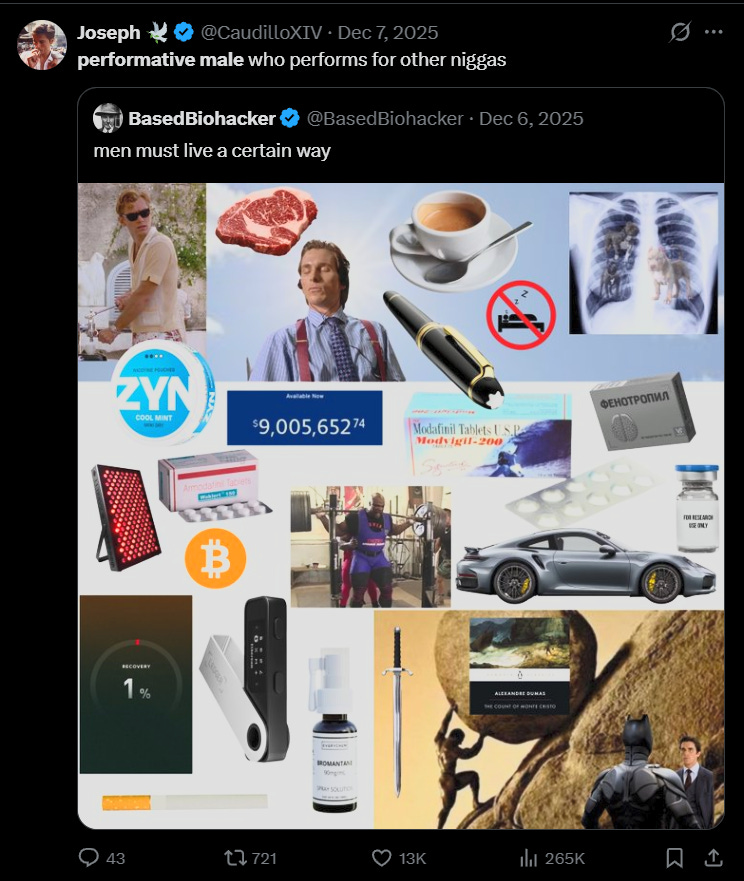
I chuckled, as I have that exact box of Modafinil in my exotic pharma collection.
So, I guess you could say that this version of the performative male who performs for other niggas is “literally me.”
However, when I looked it up, it seems that the version of “performative male” I’ve been encountering had only appropriated the phrase and repurposed it.
There appear to be two separate “performative male” discourses running parallel to one another.
One is a feminist critique of male feminists, and the other is men using the word “performative” to accuse each other of inauthenticity.
The words “masculinity” and “performance” have been paired together like chocolate and peanut butter in feminism and gender theory for decades. This all flows from their rejection of human nature and a religious belief that men and women are fundamentally interchangeable, making all behavioral sex differences mere hollow “performances” meant to satisfy culturally constructed expectations. Male feminist Jackson Katz called it a “tough guise,” and numerous activists and pandering grifters have called it the “mask of masculinity.”
So clever…
But what’s interesting about the recent trend of feminists criticizing “performative males” is that they are criticizing males who are pretending to be feminists.
“Performative males” are theoretically straight men who are “performing” feminism. They are pictured wearing clothes with feminist slogans, conspicuously reading feminist books or books about powerful women, and showing interest in cultural things that urban female Democrats seem to like. They’re what the right calls “soyboys,” and they’re probably a more familiar sight near colleges and in the downtown areas of left-leaning cities—places with artisan coffee shops—than they are where I live.
Many feminists appear to be suspicious that some of these men have ulterior motives, and that pretending to care about feminist causes may just be a strategy to have sex with feminist women. Imagine Patrick Bateman lecturing everyone at the table about the importance of achieving women’s equality.
There can be no doubt some of that is going on. Male feminists and “white knights” have long been accused of being gamma males using the “sneaky fucker” strategy. The phrase “sneaky fucker” actually comes from scientists studying the animal world who noticed that while the most dominant males are competing with each other, lower-ranked males sometimes sneak around them and mate with their females.
Some of these accused “performative males” probably are “sneaky fuckers.” And it seems that almost every prominent heterosexual male feminist is eventually accused of some sexual misconduct—from Michael Kimmel to celebrities like Louis C.K., James Franco, and Neil Gaiman.
Just as the men who condemn other men for infidelity the loudest are often later found to be cheaters, we can expect that the predatory performative males will performatively accuse other men of being predatory performative males.
But I suspect that many of these so-called performative males are simply desperate for female attention or approval. There are probably some mommy issues there. These guys are trying to be who they think women want them to be and say what women want them to say, not realizing that adopting the interests and opinions of one’s target audience is a far more successful mating strategy for women than it is for men. Most women want confident men who know who they are, and women lose respect for and attraction to men who rely on their approval.
Whether these “performative males” are sneaky fuckers or just clueless men who are trying to say and do the right thing, while it is true that this strategy may work to get the occasional feminist into bed, it will ultimately lead either to allegations of misconduct or a seat in the cuck chair.
But, what of the other “performative male,” the one who “performs for other niggas?”
The Language of Performance
Well, the word “performative” is generally meant as an insult. It’s meant to trivialize and indicate that someone is play-acting or “faking it.” It suggests that someone is only doing something to be seen doing it, and not because it represents a sincere interest or enjoyment.
This is one of those situations in which metaphors are overextended, and language distorts rather than describes natural human behavior. It is normal for our species for men and women to “perform” acts to impress both our own sex and the opposite sex. Males and females have different sex “roles,” and we “perform” acts to satisfy those roles.
The language seems to “portray” us as “actors performing roles” and implies that we are all essentially “lying” or “faking.” This is the kind of wordcel wordtrap that lends itself to Marxist gender theory ideology and postmodernist thinking.
“Nothing is real, everything is fake. Everything is a performance.”
That’s a frame, but it isn’t the whole picture.
Men are primates. We imitate each other. Monkey see, monkey do. And yes, we do things to try to impress each other. You can frame that in a way that seems trivial or superficial, but it is also foundational to human nature and social hierarchy.
One of the major contributions I made to the discussion of masculinity in The Way of Men was pointing out or reminding people that men select each other, and we often don’t compete for mates as directly as, say, elk, bulls, or lions. Men compete with one another for honor and status within male groups, and attaining higher status within those groups makes them more attractive to females and increases their mating options. A woman’s status in the community has very often been tied to her mate’s status.
In the past, and in much smaller human groups, the path to status—to honor within an honor group—was probably much clearer. If the group values hunting and fighting to attain higher status, you obviously have to get better at hunting and fighting, or find a way to facilitate that process and make yourself more valuable.
In the modern world, there are many paths to higher status and many male honor groups. Fewer of those groups are clearly defined, and fewer offer a straightforward pathway to honor.
So, as human men, we all do a lot of things to try to impress other men and fit into male groups.
When men do things to fit in or impress other men, it sometimes looks awkward or unnatural. But you only become confident as a man and ultimately respected as a man by trying things out to see what fits and what doesn’t.
There’s an adolescent mindset held by many people who believe that you will forever be who you were in high school, and any attempt to move beyond that is some kind of inauthentic affectation. The reality is that high school is probably when we do the most fake things to fit in or impress other people. The process of trying out new things and trying to fit into new social groups is ongoing and lifelong. As you move, take on new jobs, rise through different levels of achievement, and go through life changes, you’ll constantly have to try new things to fit in, and there will be new people at each place and level to impress.
No one at my strongman gym seems overly impressed that I have been practicing submission grappling for eight or nine years. To impress them, and “fit in,” if that is the goal, I have to demonstrate strength-based achievements. I’ve done a lot of strength-based training in the past, so I feel comfortable and confident that it’s part of my life, and I have a solid knowledge base there. But that wasn’t the case when I started. At one point, I was a weak, awkward new guy who didn’t know anything, just trying to figure things out. The same was true of grappling. “What business do I have even being here?” Now, I belong, and that is an authentic part of my identity. I’m no longer trying it out or trying to fit in.
I’ll give you another example. Whiskey.
In America, whiskey is associated with manliness. As the guy who wrote The Way of Men, my readers expected me to drink whiskey. Men wanted to meet me and buy me whiskey. And they did. And I accepted, many times. I wanted to fit in. I wanted the guys to like me. I’ve been to whiskey tastings, and I’ve tried all kinds of whiskeys and bourbons, high and low end. I have attempted to appreciate whiskey. But even after many years of doing this, I would never go out of my way to order a whiskey on my own. It’s just not my favorite thing. But I would never have known this had I not made the attempt. I know men who can spend half an hour talking about whiskey.
The same is true of cigars or any number of things that men start doing “performatively” to fit in with other men. For some, it becomes an authentic part of their identity. Others try it out and end up passing on it or moving to different social spheres.
So often, men use the language of performance to degrade the pursuits of men in other groups, dismiss things they don’t themselves enjoy, or downplay things they aren’t good at.
Drinking whiskey, smoking cigars, popping ZYNs, and adopting new fitness trends are all fairly arbitrary cultural measures of manhood. But every tribe that has ever existed has had its own cultural quirks like this.
It is true that some men seem to have paper-thin identities based on a series of signifiers and habits they have adopted. It is also true that most people aren’t that deep and are pretty boring and basic.
But none of us are “above” doing things to impress other men or trying something out to show we want to be part of a particular group of men. We can understand what we are doing and why, but asking us to stop doing it is expecting us to stop behaving like human males.
Something is lost in translation when we use the language of “performance” to trivialize behaviors that are healthy and normal for our species.
I was raised around a lot of Gen X guys even though I was slightly younger, and I worshipped at the altar of authenticity for a long time. In some ways, I still do.
But you can see the purity spiral get out of control with it: eventually, you have to give the impression you were pushed out of the womb with a fully formed identity you were perfectly comfortable with, and any indication otherwise is allowing a weakness. The mask can’t have any visible seams.
And that’s idiotic. It doesn’t allow for what you can do with self-creation and commitment. Most other things I believe in come back to placing reason over comfort, being who you decide to be, what’s right to be, instead of just doing what feels “natural” which is usually stasis. We need room for that.
Francis Fukuyama (the End of History guy) has written about the Greek idea Thymos, the need to be esteemed by those we hold in high esteem. This has made a lot of sense to me since I first read it. That kind of esteem is, I would say, hard to earn. Short cuts are always a temptation. Such as making yourself an expert in a niche area.